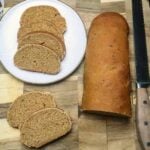
Swedish Limpa Bread with Fresh Milled Flour
This delightful seasonal Swedish bread is perfect for your family traditions this holiday season! Made with fresh milled flour, it's nutritious, wholesome, and incredibly delicious.
Servings: 12
Calories: 169kcal
Cost: $10
Ingredients
- 1 cup orange juice 8 ounces (240 grams)
- 1/2 cup milk 4 ounces (120 grams)
- 2 tablespoons butter 28 grams
- 1/4 cup molasses 70 grams
- 1 teaspoon anise seeds
- 1 teaspoon fennel seeds
- 1/2 teaspoon caraway seeds
- 1 cup whole grain rye flour 130 grams
- 2 1/3 cups whole white wheat flour 303 grams
- 2 teaspoons instant yeast 6 grams
- 1 teaspoon salt 6 grams
- 1 tablespoon orange zest 6 grams
Instructions
- In a small pot, bring the orange juice, milk, butter, molasses, anise, caraway, and fennel seeds to a low boil for 5 minutes. Cool for a few minutes.1 cup orange juice, 1/2 cup milk, 2 tablespoons butter, 1/4 cup molasses, 1 teaspoon anise seeds, 1/2 teaspoon caraway seeds, 1 teaspoon fennel seeds
- Weigh, measure, and/or mill your whole grain flours into a mixing bowl. (This recipe works great with fresh milled flour). Add the slightly cooled liquid to the flours and mix to combine until no dry bits of flour are left. Let this mixture rest until the dough temperature is 110°F or lower, around 30 minutes. Do not skip this rest, and test multiple spots of the dough to make sure there aren't hot spots.1 cup whole grain rye flour, 2 1/3 cups whole white wheat flour
- Sprinkle the yeast, salt, and orange zest on top of the dough and begin to knead for 3 to 5 minutes until the dough is smooth and supple. You can knead by hand or with a mixer.2 teaspoons instant yeast, 1 teaspoon salt, 1 tablespoon orange zest
- Place dough in a warm place and let rise for 1 hour or until doubled.
- Punch the dough down and pour out onto a clean work surface. Lightly flatten the dough to form a rectangle shape. Roll the bread up like a jellyroll and pinch the ends closed. Place the shaped loaf onto a baking sheet lined with parchment paper. Cover with a damp tea towel and let rise for 45 minutes or until puffy.
- Toward the end of the second rise, preheat the oven to 350°F. Bake the loaf for 40 minutes or until the internal temperature of the bread is at least 190°F when tested with a thermometer.
Notes
- Use a kitchen scale to weigh ingredients for best results.
- Rye makes bread doughs more dense and sticky. It can seem odd if you aren't used to baking with rye. To keep the bread from becoming too dense, make sure the dough is moist.
- Doughs with rye should be tacky, but manageable. If you feel it is too dense as you're kneading, you can add a little more milk a tablespoon at a time. Rye does well at a high hydration. However, do not let the dough become glue-like.
- Rye is lower in gluten, so it will not develop gluten the way other bread doughs do. For that reason, do not over knead. Knead the dough for only a few minutes--just to a point that it is smooth and supple.
- Put the dough in a warm place to rise. This, combined with a moist dough, will help prevent your bread from becoming too dense.
- As the dough is rising, keep it covered with a damp tea towel. This will prevent the dough from drying out, which will give you a better rise.
- Cool completely before slicing, at least 2 hours. Rye is prone to turning "gummy" if it was sliced before it was cooled. It needs that cooling period to firm up its structure.
Nutrition
Calories: 169kcal | Carbohydrates: 32g | Protein: 5g | Fat: 3g | Saturated Fat: 1g | Polyunsaturated Fat: 0.2g | Monounsaturated Fat: 1g | Trans Fat: 0.1g | Cholesterol: 6mg | Sodium: 217mg | Potassium: 245mg | Fiber: 4g | Sugar: 8g | Vitamin A: 120IU | Vitamin C: 11mg | Calcium: 53mg | Iron: 1mg
